

Demonstration of Auditory Chimaeras Based on Envelope and Fine Structure #
When we hear a sentence, a melody, or judge whether a sound comes from the left or the right, the brain does not process sound as an indivisible whole. Instead, the auditory system makes use of different layers of acoustic cues, among which two of the most important are the envelope and the fine structure.
In simple terms, the envelope describes the slower variations in sound amplitude over time, such as rhythm, pauses, and changes in intensity in speech. In contrast, the fine structure reflects the faster and more subtle oscillatory details within the sound waveform, and is usually closely related to pitch, timbre, and temporal cues used in spatial hearing. In other words, “understanding what is being said” and “perceiving sound quality, pitch, or direction” do not necessarily rely on the same type of information.
A classic question: which part of sound do we rely on more? #
To address this question, researchers proposed a very elegant method: the auditory chimaera. The basic idea is to decompose two different sounds into multiple frequency bands, extract the envelope from one sound in each band, combine it with the fine structure from the other sound, and then resynthesize them into a new hybrid sound.
The advantage of this approach is that if listeners perceive the resulting sound as being more similar to the original sound that provided the envelope, then the task is likely to depend more on envelope cues. Conversely, if the percept is more similar to the sound that provided the fine structure, then fine structure is likely to play the more important role.
Schematic illustration #
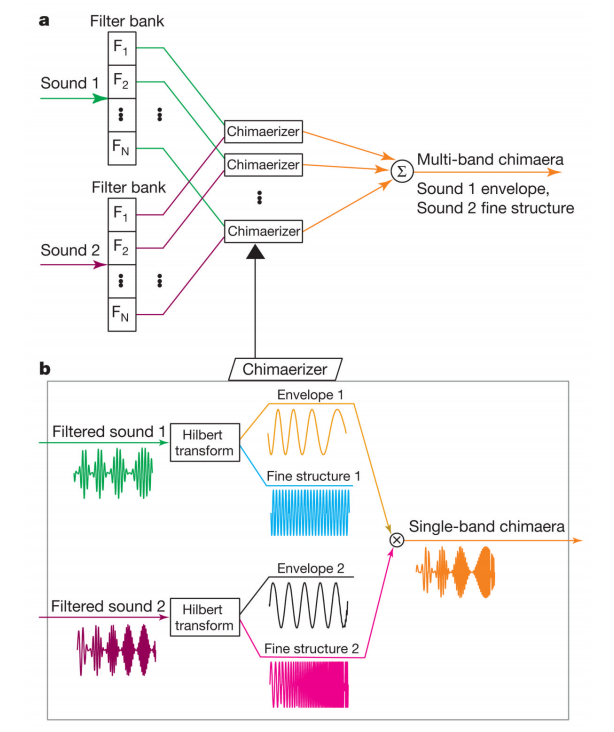
Figure 1. Basic processing framework of the auditory chimaera. The left panel illustrates how two sounds are filtered, decomposed into envelope and fine structure, and then recombined. The right panel uses two speech tokens as an example to show how the envelope from one sound can be combined with the fine structure from another.
What do envelope and fine structure each contribute? #
One of the most insightful findings from this line of research is that different auditory tasks rely on different acoustic cues.
In speech recognition, human listeners often rely more heavily on envelope information. This means that even when the rapid oscillatory details of a sound are altered, listeners may still be able to recognize the general speech content as long as the envelope is preserved.
However, in melody perception, pitch judgment, and spatial hearing, fine structure usually plays a more prominent role. Put differently, the envelope is more important for helping us understand what is being said, whereas fine structure contributes more to perceiving what the sound is like, how high or low it is, and where it comes from.
Audio Sample 1: [mā] #
Audio Sample 2: [jù] #
Audio Sample 3: Envelope of mā + Fine structure of jù #
Audio Sample 4: Envelope of jù + Fine structure of mā #
These examples illustrate that speech content is dominated mainly by the envelope, whereas lexical tone is dominated mainly by the fine structure.
Why does this matter? #
Understanding the division of labor between envelope and fine structure is not only a fundamental question in auditory science, but also has direct implications for hearing technology.
For example, in the design of cochlear implants, hearing aids, and speech processing algorithms, if the primary goal is to improve speech intelligibility, then preserving envelope information is especially important. But if the goal is to further improve music perception, pitch experience, or sound localization, then how to better preserve or reconstruct fine-structure-related cues becomes a more challenging and critical issue.
Therefore, envelope and fine structure are not in a relationship where one is simply “more advanced” or “more important” than the other. Rather, they represent two complementary types of information with distinct roles in the auditory system. Together, they shape our rich and stable experience of sound.
References #
Smith, Z. M., Delgutte, B., & Oxenham, A. J. (2002). Chimaeric sounds reveal dichotomies in auditory perception. Nature, 416(6876), 87-90.